

Product schema for adult e-commerce is the structured data markup that tells Google what a product page sells, what it costs, and whether it’s in stock, so adult stores can qualify for rich results even in a niche where standard snippets are often off limits.
If you sell lingerie, wellness devices, or sex products online, you’ve probably noticed Google treats your industry differently. The review stars and merchant badges that mainstream stores get for free rarely show up on adult catalogs. That doesn’t mean structured data is a waste of time, though. Done right, product schema for adult e-commerce still helps search engines read, sort, and surface your listings correctly.
This guide covers what to include, what to leave out, and how to build a product schema for adult e-commerce setup that holds up in practice.
What Product Schema Means for Adult Stores

Product schema is a form of structured data, written in JSON-LD, that sits in your page’s code and describes a product in a format search engines can parse directly. It covers the name, brand, price, currency, condition, and stock status of every item.
For a mainstream retailer, this markup usually unlocks star ratings, price snippets, and shopping carousels. Adult stores get a smaller slice:
- Google has said outright that it won’t show review rich snippets for adult products or services.
- Shopping-specific rich results are mostly off the table for adult merchants.
- Basic Product schema, Offer schema, and Organization schema still get crawled and indexed like anywhere else.
So the goal changes. Instead of chasing star ratings, adult store owners are better off giving crawlers a clean, unambiguous read of the catalog. Get the markup right, and it still helps with indexing speed, categorization, and the rich results that are actually available.
Why Rich Results Adult Products Still Matter

Reviews are off the table, but a few wins are still there for the taking. Price and availability snippets aren’t blocked the way reviews are, and they give a shopper a reason to click through. Breadcrumb rich results show where a product sits in your catalog before someone even lands on the page. Clean schema also helps Google represent your whole domain better, not just one listing, through things like the sitelinks search box. And structured data increasingly feeds AI Overviews and answer engines, which summarize product details without showing a traditional snippet at all.
Chasing the rich results adult products can realistically earn is a better use of time than arguing with Google over review stars it has already ruled out for the category. That’s the case for treating product schema for adult e-commerce as its own project rather than something a plugin handles by default.
Core Properties Every Adult Product Schema Needs
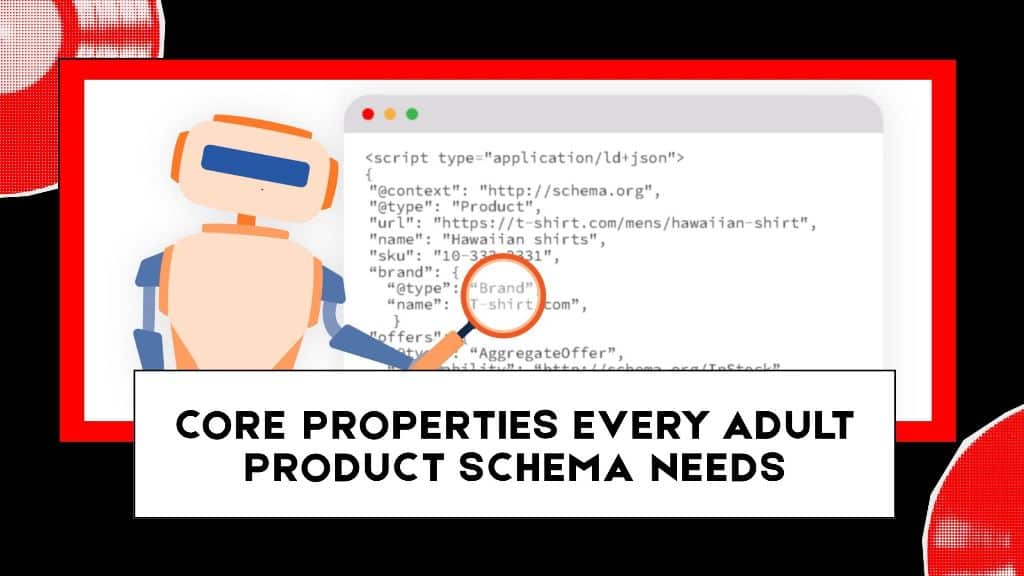
A working schema markup sex products template needs, at minimum:
- name: the exact product title as it appears on the page
- image: a direct URL to a high-resolution product photo
- description: a unique summary, not copied from another listing
- sku and mpn: identifiers that help Google match your listing to others
- brand: the manufacturer or your private-label name
- offers: a nested Offer object with price, priceCurrency, availability, and url
- category: the product type, useful for internal categorization and filtering
Leave aggregateRating out entirely. Review snippets won’t render for adult catalogs anyway, and including the property just invites validation warnings for no benefit.
Every value needs to match what a shopper actually sees on the page. Schema that contradicts the visible content reads as a spam signal, and that’s a bigger risk for stores already operating in a sensitive category. Get these fields right, and you have a working product schema for an adult e-commerce catalog.
Step-by-Step: Implementing Product Schema for Adult E-Commerce

- Audit your current templates. Check whether your platform (Shopify, WooCommerce, Magento) auto-generates Product schema, then pull a sample page to see what’s missing.
- Map your fields. Match each schema property to the corresponding field in your product database so pricing and stock stay in sync automatically.
- Write the JSON-LD block. Place it inside a <script type=”application/ld+json”> tag in the page head or body. Don’t inline it as microdata scattered across the HTML; it’s harder to maintain that way.
- Exclude restricted properties. Leave out review and aggregateRating markup on adult listings since Google won’t render them.
- Test before publishing. Run the page through validation tools and fix every error and warning before it goes live sitewide.
- Monitor Search Console. Watch the Enhancements report for Product snippet errors after rollout and fix any pattern that keeps showing up.
Roll out product schema for adult e-commerce template by template rather than product by product. It’s easier to keep consistent and easier to audit later.
Common Mistakes Adult Store Owners Make

A handful of problems show up over and over when stores try product schema for adult e-commerce without much of a plan. Copying a generic e-commerce plugin’s output without editing it leaves irrelevant review markup in place. Placeholder prices or “in stock” values stop matching the live page pretty quickly if nobody’s watching. Duplicated product descriptions across variants weaken both the schema and the on-page content around it. Forgetting to update availability when something sells out creates a mismatch that gets flagged during crawling. And adding schema only to a handful of hero products, instead of the whole catalog, leaves most listings without any structured data at all.
Fixing these basics usually matters more than chasing advanced properties. A clean, consistent setup beats an elaborate one that’s half-broken.
Testing and Validating Your Structured Data Adult Store Setup

Before pushing schema live across a catalog, run it through Google’s Rich Results Test and the Schema Markup Validator. Both flag missing properties and formatting errors right away.
A few habits are worth building into the workflow. Re-test after every platform update or theme change, since these tend to strip custom code without warning. Spot-check a random sample of product pages every month instead of assuming the template holds everywhere. Keep a changelog of schema edits so you can trace back when an error was introduced.
This kind of ongoing structured data adult store maintenance is the difference between markup that quietly does its job and markup that breaks silently and stays broken for months without anyone noticing.
How This Fits Into a Wider Adult SEO Strategy

Schema markup is one piece of a bigger technical picture, and product schema for adult e-commerce works best when it supports the rest of the site instead of sitting off on its own. Page speed, mobile usability, crawlability, and content depth all shape whether Google trusts your catalog enough to index and surface it consistently.
Our adult e-commerce SEO services cover the broader strategy that structured data supports, from keyword research to content planning. If your catalog runs video previews or cam-adjacent content alongside product pages, it’s worth reading schema markup for adult content, cam, and video pages too, since a lot of adult e-commerce sites run both formats side by side.
Conclusion
Product schema for adult e-commerce won’t unlock every rich result that mainstream retailers get, but it still shapes how search engines read, trust, and rank your catalog. Keep the markup clean and accurate on every product page, skip the properties that Google won’t render for this category anyway, and check the setup regularly rather than assuming it still works.
If you’d like a technical audit of your current product schema for adult e-commerce setup, get in touch with us, and we’ll walk you through what’s working and what needs fixing.