

AI-Generated Adult Content can hurt your SEO, but only if you publish it carelessly: at scale, unedited, and with nothing original to say. Google has never penalised a page just because a machine helped write it. What follows are pages that are thin, copied, or useless to the reader, whoever or whatever made them. The problem, in short, is how you work, not the tool you work with.
TL;DR
- Google doesn’t ban AI content. It buries low-quality content.
- AI-Generated Adult Content only gets risky when it’s churned out at volume, duplicated, or never edited.
- The real dangers are scaled content abuse, thin pages, and weak trust signals.
- Human review, originality, and solid E-E-A-T keep your rankings safe.
What Google Actually Thinks About AI Content
Google’s position is pretty plain. It rewards helpful, reliable, people-first content and doesn’t care what tool made it. Using AI to help you write is fine, and plenty of sites already ranking on page one do exactly that. The idea that AI writing is some automatic red flag just doesn’t hold up.
What it does come after is content built mainly for game rankings instead of helping anyone. That line matters a lot for adult sites, where competition is brutal, and the urge to publish fast is constant.
So AI-Generated Adult Content sits in the same boat as everything else. Quality decides the outcome, not who or what typed the words. A page a person wrote can be just as spammy as one a model wrote, and a page a model helped with can be every bit as good as one done entirely by hand.
Does Google Treat Adult Sites Differently?
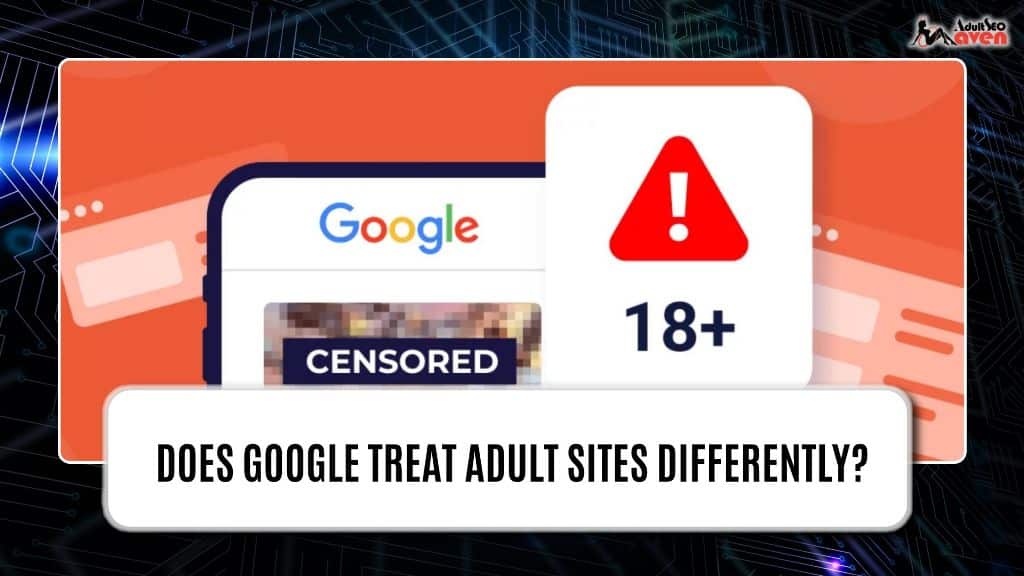
There’s a common myth that adult sites get automatically demoted in search. They don’t. Google runs the same core ranking systems across every niche, then adds SafeSearch filtering on top so explicit results stay away from people who haven’t opted in.
That filter changes who sees your pages, but it doesn’t punish you for using AI. The takeaway is reassuring. Follow the usual quality rules, and your site competes on a level field. Your job is to make sure the content behind that filter actually deserves to rank. The explicit nature of your niche is just context. It is not a reason to drop your editorial standards.
Where AI-Generated Adult Content Becomes an SEO Risk

Trouble starts the moment speed replaces substance. Most penalties tied to AI-Generated Adult Content come down to a handful of mistakes you can avoid:
- Pushing out hundreds of near-identical pages with a few keywords swapped.
- Writing descriptions that sound robotic and tell the reader nothing new.
- Ignoring search intent and cramming keywords into every paragraph.
- Skipping fact-checks, so inaccurate or misleading claims slip through.
- Adding no original images, no real context, and no actual expertise.
Each of these tells Google the page was built for search engines, not people. That is what drops your rankings and costs you visibility.
Also Read : GEO for Adult Websites: Getting Cited by ChatGPT, Perplexity, and AI Overviews
The Scaled Content Abuse Problem
In its March 2024 spam update, Google added a policy aimed at scaling content abuse. It penalises churning out large batches of pages mainly to game search results, whether a machine made them, a person made them, or both did.
For adult publishers, that is the warning to pay attention to. Spinning up thousands of templated galleries or video descriptions looks a lot like the behaviour Google is trying to clear out of its index. Pages made that carelessly are far more likely to pick up a manual action or get quietly buried by the algorithm.
The fix is simple enough: choose depth over volume. A smaller set of well-made, useful pages will nearly always beat a bloated catalogue of filler nobody wants to read or share. Ask whether each new page earns its spot, or whether it just bumps a number on a dashboard. Volume for its own sake stopped working years ago.
E-E-A-T and Trust Signals in the Adult Niche
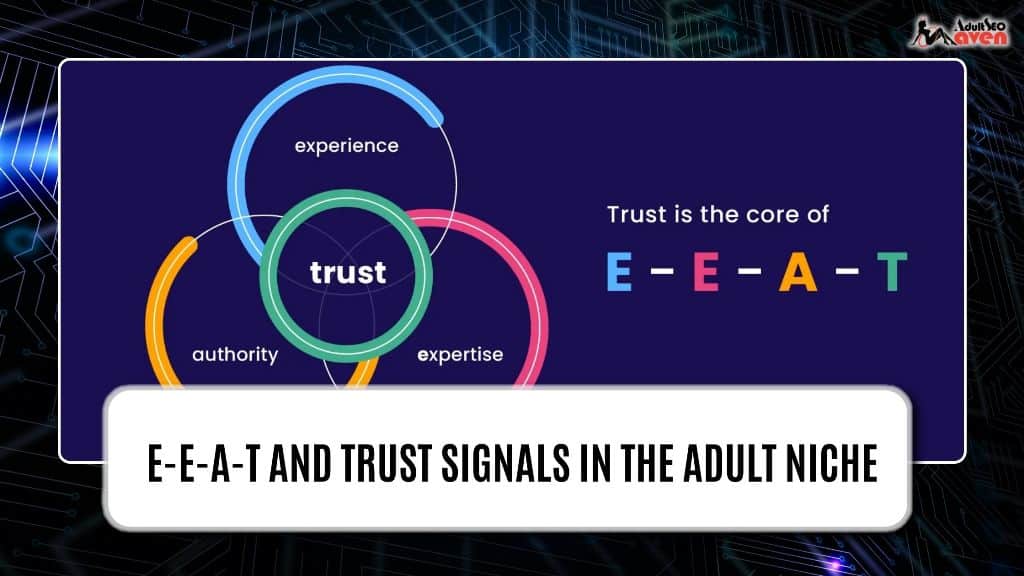
E-E-A-T stands for experience, expertise, authoritativeness, and trustworthiness, and it’s one of Google’s core quality frameworks. Adult sites tend to be held to a high trust bar because they deal with sensitive topics, payments, and user safety every day.
AI-Generated Adult Content can fall short here, since a machine has no lived experience and no real authority of its own. Pages that read as generic or impersonal send weak trust signals, and over time, those signals pull your rankings down.
A few practical things build that trust back up:
- Show clear authorship and visible editorial review.
- Add real reviews, ratings, or first-hand commentary.
- Make age-verification and compliance details easy to find.
- Link out to credible, relevant sources where it fits.
If you’d rather not learn all of this the hard way, working with a specialist adult SEO team can save you a lot of expensive trial and error.
Duplicate and Thin Content Risks

Adult niches are crowded, and AI tools trained on similar data tend to spit out similar text. That creates two problems worth watching:
- Duplicate content, where several pages, yours or a rival’s, say almost the same thing.
- Thin content, where a page offers little beyond a keyword and a one-line caption.
Both water down your authority. AI-Generated Adult Content that just rewrites what already ranks gives Google no reason to pick you over the page you copied. In a crowded field, originality is your best defence.
One safeguard goes a long way. Run every batch through plagiarism and similarity checks, then rewrite anything that overlaps too much with pages already live, whether they’re yours or somebody else’s.
How to Use AI-Generated Adult Content Safely

You don’t have to drop AI to stay safe. You just need a disciplined workflow with a human in the loop. These habits keep AI-Generated Adult Content on the right side of Google’s guidelines:
- Treat AI output as a first draft, never a finished page.
- Edit every piece for accuracy, tone, and originality.
- Match each page to a clear search intent before it goes live.
- Add something of your own, like an opinion, a comparison, or exclusive media.
- Keep keyword use natural and skip the obvious over-optimisation.
- Keep your technical SEO tight, with fast load times and a clean structure.
Done this way, AI-Generated Adult Content is a productivity tool, not a liability. It lets you scale sensibly while keeping the human judgment that search engines reward.
User signals matter too. When someone lands on a page and bounces straight off because the writing feels hollow, Google notices. Good content holds attention, and that attention feeds back into better rankings over time. A page that answers what someone actually came looking for tends to keep them around, and that is the signal you want.
A Quick Risk Self-Audit

Before anything goes live, run a quick mental check. It takes a minute and heads off most problems early:
- Does this page answer a real question a visitor is actually searching for?
- Have I added something a competitor’s page doesn’t already have?
- Has a human read it end-to-end and fixed anything awkward or false?
- Are the claims accurate, current, and easy to verify?
- Is the page fast, mobile-friendly, and free of broken elements?
Get these five things right, and you’re almost certainly fine. A single no means fix it before you hit publish.
Conclusion
So, is AI-Generated Adult Content an SEO risk? It can be, though it doesn’t have to be. The tool itself is neutral. Your standards are what decide how it turns out. Sites that lean on AI for lazy, copy-paste, mass-produced pages will eventually feel Google’s quality systems bite.
Sites that use it to support original, well-edited, helpful content get faster production and no penalty. The smart play is balance. Let AI do the heavy lifting and let skilled people sign off on quality, compliance, and trust before anything ships. Search engines keep getting better at spotting lazy filler, so the room for cutting corners shrinks with every core update.
Ready to grow your traffic without gambling on a penalty? Contact us for a dedicated adult SEO package and turn AI-Generated Adult Content into a steady, long-term ranking advantage.